Sunday, April 24, 2011

Leafcutter ants

        These are photos taken under pressure, was the end afternoon and a big storm was on the way, these usually run the production when they feel the storm approaching, and at my side there was little time to take the pictures too. They work in a line formation and from the shoots I was able to produce two keepers:

Leafcutter ants in group, in the leaf is possible to observe a soldier raider. Photo by Gustavo Mazzarollo available for license on Alamy


        And a similar, same ants with small time difference, isolated from the other in line ants:


Leafcutter ants soldier and raider isolated. Photo by Gustavo Mazzarollo available for license on Alamy

        Notice the raider ant is very important as it protect the workers against flies to land in leaf and oviposing in the worker's head.

        I wasn't sure what of the two will work better, as image, and online feedback is very important. Here opened a very interesting and "dual mode" feedback, these images received unexpectedly few comments in the macro photography forums, but in a very interesting way they were successful on Flickr being the first two in the year to reach explore (the 500 selected photos uploaded in a day). In a positive manner, each media returned feedback of people who prefer the first, for the teamwork spirit and the ones who prefer the second for better isolated subject. This stalemate of images is good but I'm not sure if they are truly similars or takes of the same scene that resulted in very different mod images, and not sure if I could get a response some day.


        From the photography perspective, is worthy to note the ground looks well in the ants perspective (if I were from the size of a ant and with a mini camera would need to crouch to achieve this perspective), and if they were really in the ground the frontal element of the lens would need to be below the ground to achieve this perspective. But these photos were made in the corner of my water tower:


         The dirt worked to create a illusion of soil, and the angle allowed for include some of it as background and even show the ants at the insect level.

Monday, March 21, 2011

The honeydew hungry ants

These ants feed on the nymph's honeydew drops, the nymphs get it from the vegetation and feed the ants in exchange of protection, I believe the honeydew even increase the ants agressiveness as they become more active and prone to attack when near a scene like this.

My ambition was to capture a image with the ants at the moment of feed and this group of nymphs produced small drops in relatively frequent quantities, the site for the capture was selected in base of this.
Side view of a honeydew hungry ant at the moment the nymph released the honeydew. This photo is with Canon MP-E 65mm macro at almost 2x magnification on Canon 7D and is a stack of two photos. The main photo is with f/7.1, effective aperture of f/21 with a estimated DOF of about 0.4mm. This was the best photo at iso 100 Photo by Gustavo Mazzarollo available for license on Alamy

Macro photography favour stop motion usually with flash photography, there's a balance where the challenge is to produce the best possible frozen moment, at the magnification that give at the same time detail and surroundings information (usually increasing the magnification results in huge light losses) with the less possible flash time. Macro photography also favour low iso.

Unfortunately in this first photos where affected by motion blur to some extent (longer flash times to work with the small apertures needed to capture two subjects interacting in one frame photo).

Usually the macro technique for insects involve reduce movement by the photographer side and by the subject side, reducing the subject side usually is done by the use of sugar, some substances that work as anaesthetics, or taking the shoots at cold hours where the insects are motionless. Unfortunately the objective of wasn't to take the pictures of ants, or of the nymphs, but photos of the interaction of them so reducing subject motion is not desired in this circumstance.

The best I could imagine for this is reducing the flash duration time while at the same time using narrower apertures to increase depth of field, this time raised the iso to 500 (proved to not harm this much the pictures, noise still under control)  and was possible to reduce the flash time. This increased the rate of keepers and proved to be a good solution for a situation where the subjects where relatively unpredictable.

For reducing the motion at my side I used a monopod (not used in the first photos) to reduce the fatigue waiting for a moment in a relatively uncontrolled scene This scenes were in a bush at 1.20m from ground so the monopod helped with the need to keep the gear lifted for longer time.

Ant waiting for the honeydew from the nymphs, this one is more magnified, with Canon MP-E 65mm lens at almost 2.6x magnification. Same nominal aperture of f/7.1 but more extended lens result in a effective aperture of f/26, as the magnification increased the depth of field decreases I estimated to about 0.3mm. Photo by Gustavo Mazzarollo available for license on Alamy


Looks the difference of exposure and aperture to not be that big among these two pictures, but the second one have better histogram distribution and a much smaller flash time than the first resulting in a more detailed capture. Personally I prefer the moment of the first photo, but the second I consider better technically, even at 200% magnification the noise differences weren't noticeable (the same amount of noise reduction was used in the two pictures). As a disclaimer, raising iso's at macro photography is a techinique of exception, most of the time the subjects weren't this active to require raising iso's and the flash itself do a good job stopping the motion.

Monday, March 7, 2011

Wasp portrait above nest

With the temperatures starting to drop is time to the return of these small yellow ones always in the species of tree of the last year.

This photo is called a single frame image, just one shoot not stack,
f/9 | 1/100s | iso 100 | manual flash at about 1/4 power
Canon 7D with Canon MP-E 65mm @ 5x.
580 EX II flash bracket mounted with a LumiQuest Mini SoftBox diffuser


Many compositive things come into place to make the image more acceptable

This green background is the leaf were the nest is suspended, is possible to see it in the second photo. The wasp not always was positioned with the leaf behind the face, get the right moment of it demanded patience and was harder than the wasp portrait by itself. I strongly rejected a black background for this photo.

The use of f/9 and with the lens fully extended resulted in a effective aperture of f/54 and a calculated depth of field of about 0.15mm (canon booklet info) the DOF start to transition to out of focus between the antenna, I believe the part behind this could remain out of focus in this particular position.

 The use of sharpening in post processing ruined middle of face, became really cartoon like, so used very mild sharpening

The eyes were an obsession, some frames took the one at right focused and some others the left one, this frame have the best equilibrium of focus of the two sides of compound eyes a very important thing when shooting a single frame image.

Feedback is important, and previous feedback demonstrate the jaws (mouth) is considered interesting, is better to place it at least in focus there's not detail that demands high resolution to be acceptable, as the eyes so the aim of the focus is a little in front of the eyes to give eyes first priority and the jaws the second, but still readable.

These are very small above their nests comparatively.

Friday, March 4, 2011

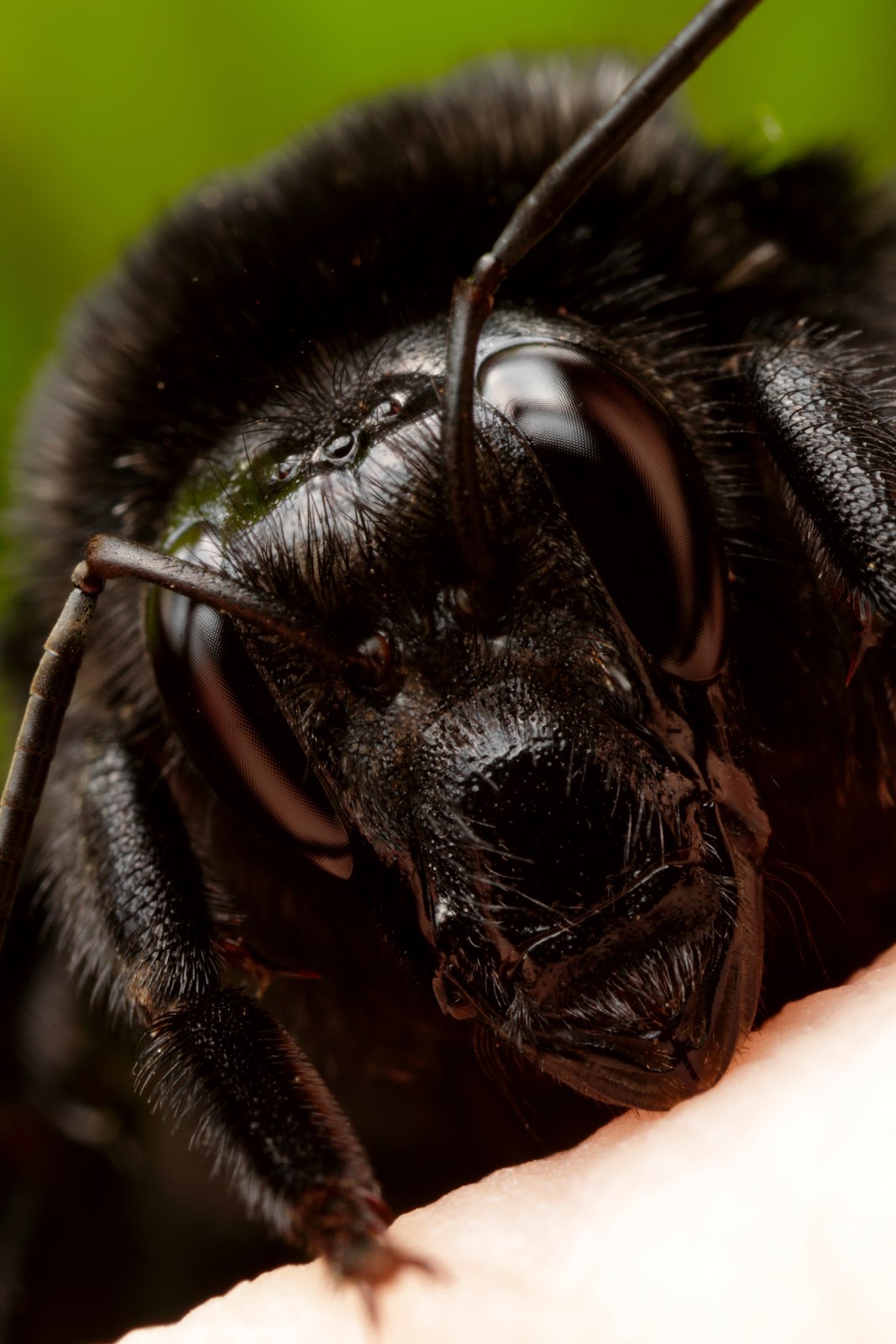
Black bumble bee portrait

Not sure if the black ones are friendly or ferocious, but this one wanted to jump to my finger for a little of heat. Not we are with the first relatively cold nights in the year. The photo is late afternoon with canon MP-E f/2.8 @ about 1.5x magnification.

Focus stack of two shoots combined in GIMP by a layer mask.

Interesting to note that the subject obligated me to keep the hand reversed and in a concave position, this was uncomfortable to left hand the lens, but the concavity of my skin worked like a reflective surface with the reflections of the skin present in the lower parts of the face.


       Scenic view above a lantana flower:


Sunday, February 20, 2011

Jumper spiderlings

Yesterday Feb 19, could return to the place and register the birth of the first jumper spiderlings

Newborn jumper spider above the silk protection constructed by the mother, the eyes look not completely formed, possibly they born blind, esp the frontal one were very hard to focus, possibly they were below the skin, interesting to compare with the well developed mother eyes and see what they will turn in future. Photo with Canon 7D and Canon MP-e 65mm macro photo @ 5x magnification 


Profile of a newborn jumper spider (salticidae) spider I opened a small hole in the silk and this individual is finding his way out of it. The green abdomen fits the green eggs, it's like the face emerge from the eggs but I do not registered this to be sure. 


Detail of a single spiderling above the protective silk and with the mother feet as scale. Photo with canon 7D and Canon MP-E 65mm macro photo lens @ 5x plus a crop 


The jumper spider mother above the newborn salticidae babies, is possible to note some eggs still closed without spider in them and some with recently born spiderlings.  


Unfortunately after 4 days of rain the thing not ended well for the spiderlings, I think the rain trapped them in the web and they died, wonder how many times the weather interfered with the small things life.