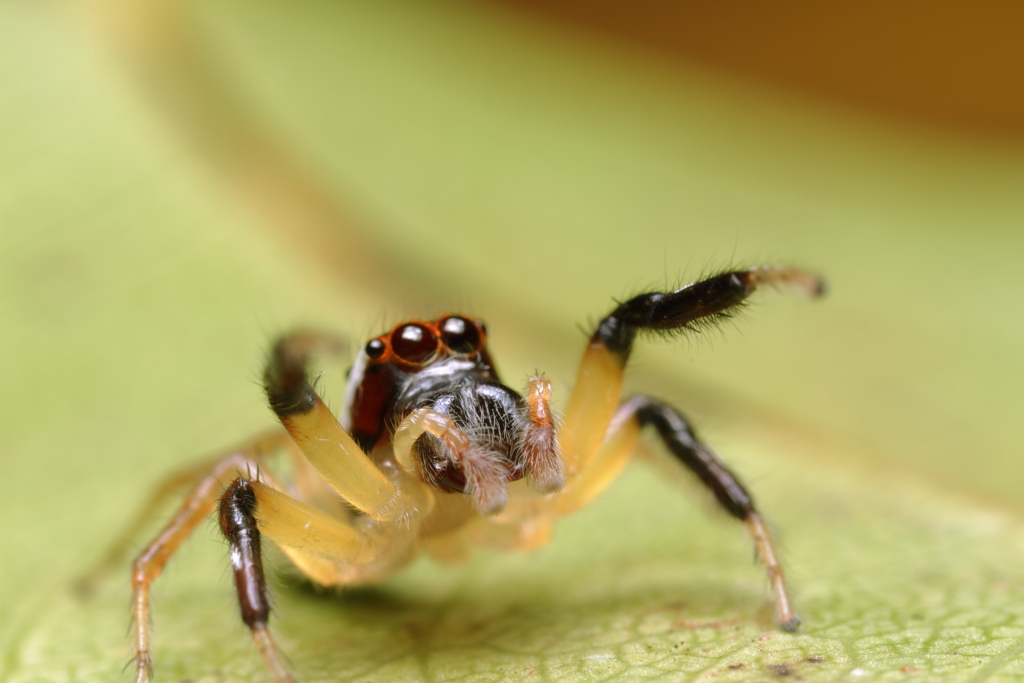
All photos with Canon MP-E 65mm f/2.8 macro @ 1.5x magnification. 580 EX II flash bracket mounted.
Sunday, February 20, 2011
Green jumper spider eggs
in Feb 16 2011 found this protective jumper and the eggs below a nice mount of silk that at same time help with defence and allow the mother to walk above the eggs without any harm.
All photos with Canon MP-E 65mm f/2.8 macro @ 1.5x magnification. 580 EX II flash bracket mounted.
At this angle the eggs are almost absent from the image but it illustrate how she is capable to walk above the silk without damaging them.
This angle is the best one to avoid the silk web and capture the eggs
All photos with Canon MP-E 65mm f/2.8 macro @ 1.5x magnification. 580 EX II flash bracket mounted.
Saturday, February 5, 2011
Jumper spider, failed jump.
The spiders of salticidae family are legendary because of several behaviour features, one of the is that they do not resist to jump to the flash diffuser during a photo session.
Moved this one inside home and tried some sequences, in this one the jumper planned a jump to the flash diffuser but gave up the jump as the diffuser was somewhat distant, is nice to see they are reluctant if a jump is going to fail.
All photos with Canon 7d, Canon MP-E 65mm macro photo lens @ about 2x, 580 EX II flash (failed in one shoot of sequence)
Moved this one inside home and tried some sequences, in this one the jumper planned a jump to the flash diffuser but gave up the jump as the diffuser was somewhat distant, is nice to see they are reluctant if a jump is going to fail.
All photos with Canon 7d, Canon MP-E 65mm macro photo lens @ about 2x, 580 EX II flash (failed in one shoot of sequence)
Friday, January 21, 2011
Mating flies
This happened yesterday, very hot summer and most of the insects were too active for photos. In situations like this the few steadier ones are in the moment of mating or feeding, just what happened to these nice couple of flies.
They were mating in the fence of my home, later afternoon and the sun was opposite to their bodies in the photo, this explain the relative background light and some light in the amber parts of their bodies. This is a combination of two photos, with Canon 7D and Canon MP-E 65mm @ about 2 x magnification, one photo had the body of male in focus and other the body of female, joined the two by working with layers in GIMP software, a process called focus stack. The photo used Canon 580 EX II flash diffused and about 1/4 or less manual power to illuminate the flies, that could appear shadowed is the photos were taken at natural light. For a scene like this the manual setting of the flash is my personal preference, the light rays from the sun hit the lens and could make things difficult for ETTL to correct measure the scene, so you would need to dial the ETTL compensation up in a guessing game, I prefer the simplicity of the manual control.
There was enough time to make two videos, one against the sun of very bad quality but the with some transparencies in the abdomen were is possible to see the movement of internal organs, and the second with the sun with incidence into the flies that document the external activity of them.
These videos were with Canon MP-E 65mm and Canon 7D
The unfortunate part for the flies was the approximation of this jumper spider (salticidae), she approached the couple and with a nice, well calculated jump assaulted the couple and killed one of them. (not sure which one as the spider escaped fast with the meal)
By the level of activity of the flies at the time of the photos would be impossible for me or for the spider to capture them, but unfortunately for the flies the fence is a not so secure place and it could first appear :(
They were mating in the fence of my home, later afternoon and the sun was opposite to their bodies in the photo, this explain the relative background light and some light in the amber parts of their bodies. This is a combination of two photos, with Canon 7D and Canon MP-E 65mm @ about 2 x magnification, one photo had the body of male in focus and other the body of female, joined the two by working with layers in GIMP software, a process called focus stack. The photo used Canon 580 EX II flash diffused and about 1/4 or less manual power to illuminate the flies, that could appear shadowed is the photos were taken at natural light. For a scene like this the manual setting of the flash is my personal preference, the light rays from the sun hit the lens and could make things difficult for ETTL to correct measure the scene, so you would need to dial the ETTL compensation up in a guessing game, I prefer the simplicity of the manual control.
There was enough time to make two videos, one against the sun of very bad quality but the with some transparencies in the abdomen were is possible to see the movement of internal organs, and the second with the sun with incidence into the flies that document the external activity of them.
These videos were with Canon MP-E 65mm and Canon 7D
The unfortunate part for the flies was the approximation of this jumper spider (salticidae), she approached the couple and with a nice, well calculated jump assaulted the couple and killed one of them. (not sure which one as the spider escaped fast with the meal)
By the level of activity of the flies at the time of the photos would be impossible for me or for the spider to capture them, but unfortunately for the flies the fence is a not so secure place and it could first appear :(
Friday, January 14, 2011
Passiflora beetle portrait
These friendly beetles live in a passiflora plant very near my home, yesterday didn't have much time to a large scan of area looking for insects so taking the most of the opportunities near home is a viable alternative.
These girls have very interesting feet physiology, serving for defence and adherence, by the means of patience for a good moment the photo registered the face and a good deal of detail of the feet. There is a crop from the feet detail:
The brush pattern in the feet adhere by a means of a "oil" in the brushes, with function as a glue, is possible to note different brushes densities (less dense in the area of contact), as they alternate the brushes used to economize oil. In the event of an attack they are able to mobilize all the brushes for a strong adherence which could avoid even a ant attack.
By the photography side the photo is with Canon 7D with Canon MP-E 65mm macro photo lens @ 3x magnification, 580 EX II flash bracket mounted, handheld. Secured the leaf with finger and folded a little to fill the background with green avoiding the black background
These girls have very interesting feet physiology, serving for defence and adherence, by the means of patience for a good moment the photo registered the face and a good deal of detail of the feet. There is a crop from the feet detail:
The brush pattern in the feet adhere by a means of a "oil" in the brushes, with function as a glue, is possible to note different brushes densities (less dense in the area of contact), as they alternate the brushes used to economize oil. In the event of an attack they are able to mobilize all the brushes for a strong adherence which could avoid even a ant attack.
By the photography side the photo is with Canon 7D with Canon MP-E 65mm macro photo lens @ 3x magnification, 580 EX II flash bracket mounted, handheld. Secured the leaf with finger and folded a little to fill the background with green avoiding the black background
Monday, September 20, 2010
White moth
The entire image of the shoot at f/16, with Canon MP-E 65mm lens at 4x, wich result in a effective aperture of f/80, the diffraction vanish all the fine detail but the DOF cover almost the entire subject.
Without the worry about preserve fine detail was possible to expose to avoid losses to highlights and strong sharpening and strong noise reduction, but the compound eyes, the most important in this photo have sufered in detail and exposure adjusts.

Crop of the above shoot, available in large size:

The entire image of the shoot at f/5, with Canon MP-E 65mm lens at 4x, wich result in a effective aperture of f/25, still into diffraction arena but much less than the usual compromisses of the apertures used at this magnification. The depth of field cover only the eyes and was possible to overexpose them for noiseless results in post processing. In post processing used very little sharpening and slight underxposed to be compatible with the image at f/16
The body of the insect lost most of the info in highlights and out of DOF parts, but will not be used for the final result.
I always aimed in the insect photos at detail in the compound eyes of the subjects, but considering they are only a small part of the subject most of the times to keep them in focus and the rest of the insect there is a need to high apertures, wich end in diffraction and motion blur and damage all the details at eyes. One viable solution if the subject is steady enough is to make two photos, one aimed at the eyes and other with longer DOF to cover all the insect, and make a "DOF stack" by layer work in post processing. The software I used was GIMP software. One third image, not present here, was used to address some highlight issues.

Crop of the above shoot, available in large size:

Without the worry about preserve fine detail was possible to expose to avoid losses to highlights and strong sharpening and strong noise reduction, but the compound eyes, the most important in this photo have sufered in detail and exposure adjusts.
Crop of the above shoot, available in large size:
The entire image of the shoot at f/5, with Canon MP-E 65mm lens at 4x, wich result in a effective aperture of f/25, still into diffraction arena but much less than the usual compromisses of the apertures used at this magnification. The depth of field cover only the eyes and was possible to overexpose them for noiseless results in post processing. In post processing used very little sharpening and slight underxposed to be compatible with the image at f/16
The body of the insect lost most of the info in highlights and out of DOF parts, but will not be used for the final result.
I always aimed in the insect photos at detail in the compound eyes of the subjects, but considering they are only a small part of the subject most of the times to keep them in focus and the rest of the insect there is a need to high apertures, wich end in diffraction and motion blur and damage all the details at eyes. One viable solution if the subject is steady enough is to make two photos, one aimed at the eyes and other with longer DOF to cover all the insect, and make a "DOF stack" by layer work in post processing. The software I used was GIMP software. One third image, not present here, was used to address some highlight issues.
Crop of the above shoot, available in large size:
Subscribe to:
Posts (Atom)